
DipHE vs HND — What’s the Difference?

DipHE vs HND — What’s the Difference?
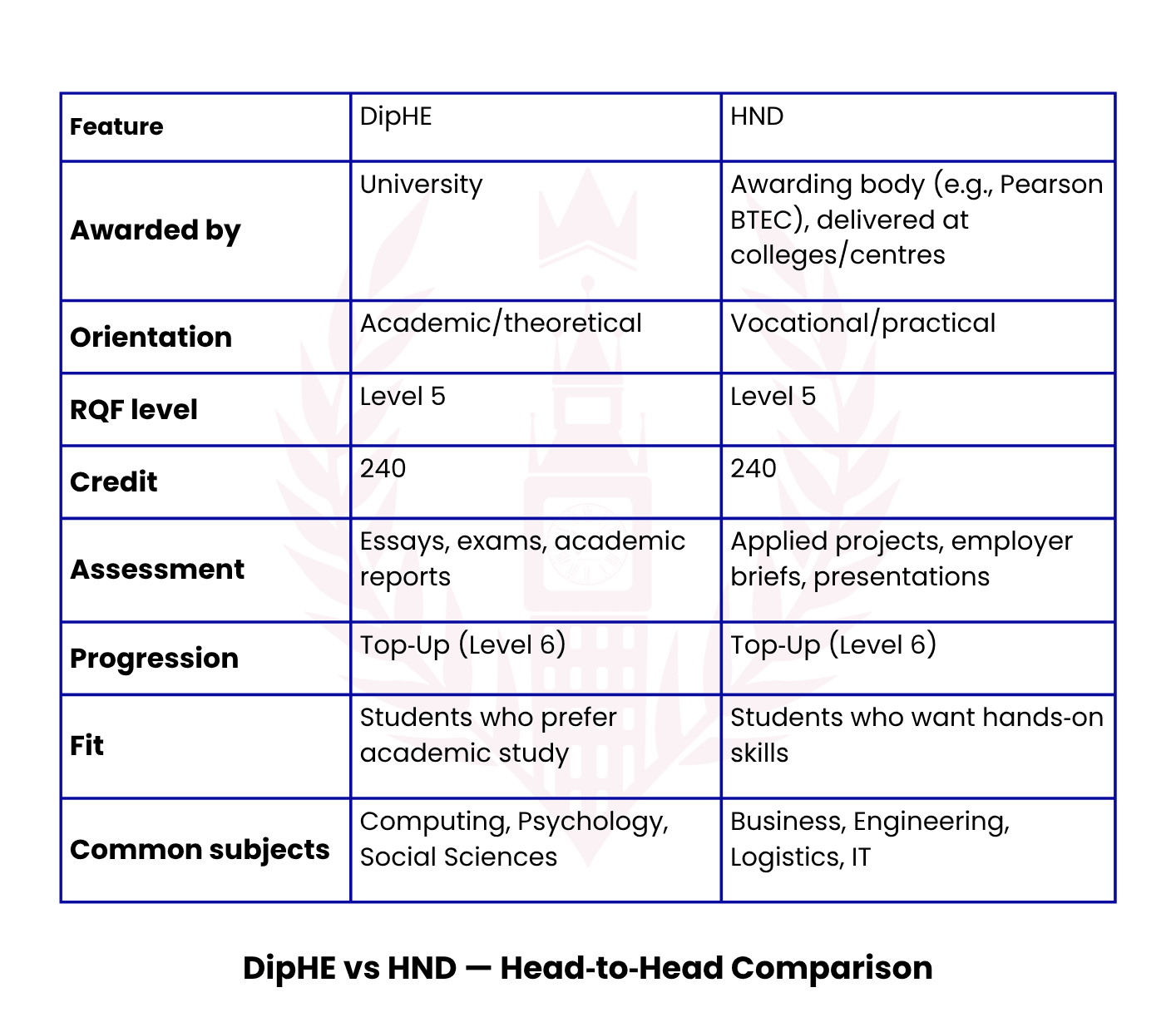
The DipHE vs HND comparison is something a lot of people are considering, especially if they want to opt for the best higher education. These are both great Level 5 options in the UK, albeit quite different. DipHE (Diploma of Higher Education) is the more academic option, whereas HND (Higher National Diploma) is the vocational option.
However, they are both coming with 2 years of undergraduate study and can lead to the Top-Up Degree (Level-6) and an eventual full BA/BSc (Hons).
Here’s what you need to know about DipHE vs HND, and what makes them different from one another.
UK Levels at a glance (RQF)
Level 4 → CertHE / Level‑4 Diploma (Year 1 of a bachelor’s)
Level 5 → DipHE / HND / Foundation Degree (Year 2 of a bachelor’s)
Level 6 → Bachelor’s Degree / Top‑Up (final year)
Read more about UK qualification levels.
Table of Contents
What is a Diploma of Higher Education (DipHE)?
Diploma of Higher Education (DipHE) is an academic qualification awarded by a university. Students earn it either intentionally (as a standalone award) or when they exit a bachelor’s after successful completion of two years.
Key features
- DipHE gets awarded by a university (degreeawarding institution)
- Level 5; typically, 240 UK credits
- Academic/theoretical emphasis (essays, research, critical analysis)
- Clear progression to Top-Up Degree (Level 6)
The important thing to consider about DipHE is that it fits learners who like academic reading, essays and seminars. It can also fit people that want to top-up and go for a postgraduate degree down the line. If you go the DipHE route, you can expect exams, case analysis, reports and essays. It doesn’t have as much workplace simulation when compared to the HND.
What is a Higher National Diploma (HND)?
Higher National Diploma (HND) is a vocational qualification with a strong practical and employmentreadiness focus. It’s usually delivered by colleges or approved centres and awarded by an awarding body (e.g., Pearson BTEC, Ofqualregulated).
Key features
- Awarded by an awarding organisation (e.g., Pearson BTEC)
- Level 5; typically, 240 UK credits
- Practical/project-based emphasis (labs, simulations, employer briefs)
- Recognised route to Top-Up Degree (Level 6)
We should note that the HND is more suitable for those people that enjoy applied tasks and projects or workshops. In general, it fits people that want a more industry-style assessment and who are looking to get job-ready skills. You can expect to have lots of simulations, presentations and more focus on practicality or portfolio projects.
Top‑Up Degree: the bridge to a full bachelor’s
The role of a top-up degree is to help transform your current, level 5 qualification into a complete bachelor’s degree (BA/BSc Hons). Generally, it takes around 1 year of full time or 2 years of part time studying. You can apply for a top-up degree if you hold an HND or DipHE, or, in some cases, if you have a foundation degree.
Before applying, you want to check if it’s subject-relevant, but also assess credit mapping. Additionally, you want to check the minimum grade and merit requirements, but also if it’s online, hybrid or on the campus.
Recognition, frameworks, and international notes
Before choosing any educational path, it becomes extremely important to think about the studying framework and recognition you get. Both of these can be extremely powerful, and have the potential to help you grow in the long run. With that being said, here’s what you want to know about DipHE and HND when it comes to regulatory factors, frameworks and international equivalence.
- Regulation: UK Level5 awards are regulated (e.g., Ofqual for HND awarding bodies; universities for DipHE). Always verify the awarding body and provider status.
- International equivalence: Outside the UK, recognition is determined casebycase. Many countries map Level5 awards to local frameworks (e.g., EQF in Europe). If you plan to work/study abroad, ask employers/universities how they treat DipHE/HND equivalence.

Entry requirements
For the DipHE, you have the standard undergrad entry, or various mature student routes. For the most part, English language evidence tends to be required. For an HND, you need to have level 3 or similar qualification, with English language evidence also being necessary in some cases.
Costs, study modes, and timelines
- Duration: 2 years full‑time (both); part‑time options common
- Study mode: On‑campus, blended, or online (provider‑dependent)
- Fees: Vary widely by provider, subject, and delivery mode. Budget additionally for materials, exam fees (if any), and Top‑Up year tuition.
One thing to note is that an HND tends to have a slightly lower cost when compared to DipHE. That’s because many of them are offered via further education colleges. But generally, the difference between these two is minimal, around £1000 or less.
Study progression
Once you complete the DipHE, you can enter the final year or year 3 of the bachelor’s degree. That becomes ideal if you want to continue your studies after gaining some financial stability or confidence. A DipHE in nursing will lead to a BSc in Nursing.
By comparison, the HND will also lead to a top-up degree that converts the diploma into a complete bachelor’s degree. One thing to note about the HND route is that some universities might set additional requirements, like getting a distinction or merit grade in your HND.
How to choose (decision checklist)
The quick checklist shown below shows how you can pick the best approach based on what you need. It’s safe to say that this will be a challenging decision, but very much a necessary one, as you try to continue your studies.
- Goal: Academic route (DipHE) or hands‑on route (HND)?
- Next step: Will you Top‑Up soon, or work first?
- Delivery: Do you need online or are you fine with campus/blended?
- Recognition: Check awarding body/university status and local equivalence.
- Curriculum: Read module lists; look for subject match to your Top‑Up target.
- Assessment: Prefer essays/exams (DipHE) or projects/portfolio (HND)?
- Budget & time: Compare total cost (including the Top‑Up year) and weekly workload.
Generally, you always want to make sure that you prevent rushing and you focus on assessing everything accordingly. Identify your goals, see if the delivery approach fits your requirements, and also if the curriculum and assessment types are something that you are ok with. Don’t dismiss costs, either, as you do want to compare the total cost and the weekly workload to see if you can have good results.
Conclusion
Both the DipHE and HND are a great option if you want to continue your studies. With that in mind, the HND has a more vocational approach, whereas DipHE focuses more on academic progression. If you see yourself pursuing any more university studies, then the DipHE might be the best option.
However, if you enjoy technical skills and want to focus on a career path sooner, then you can go for an HND. Both of them are a great educational path, but it comes down to your career path and expectations. That will usually define which one is the best option to fit your needs.
FAQ
Is HND higher than DipHE?
No. Both are Level 5. They differ by orientation (vocational vs academic), not by level.
What is the difference between HND and DipHE?
HND is vocational and project-based (often awarded by Pearson BTEC via colleges). DipHE is academic and university-awarded.
Can I Top-Up after a DipHE or HND?
Yes. With the right subject match and grades, both can lead to a Level-6 Top-Up and a full BA/BSc (Hons).
How many credits do I need to Top-Up?
Typically 240 credits at Levels 4–5 in a closely related subject.
Can I Top-Up in a different subject?
Usually you need a subject match. Some universities offer bridging modules or an extra year for adjacent backgrounds.
Which is better for international students: DipHE or HND?
HND may help with a practical, employer-facing portfolio. DipHE offers a university-branded award and often smoother academic progression.
Is an HND equivalent to the second year of a degree?
Yes. It typically represents two years of undergraduate study at Level 5 (like a DipHE). Exact credit mapping depends on the provider.
Will employers value a DipHE?
Many do, especially alongside skills, projects, and certifications.
Are DipHE and HND Ofqual-regulated?
HNDs are issued by Ofqual-regulated awarding bodies (e.g., Pearson). DipHE is a university award quality-assured under UK HE regulation (not issued by Ofqual).
Can I study DipHE/HND/Top-Up fully online?
Often yes. Availability depends on provider; check delivery mode, assessment style, and time-zone support.
Is an HND a degree?
No. It’s a Level-5 diploma. A Top-Up converts it to a BA/BSc (Hons).
How long is a part-time Top-Up?
Commonly 18–24 months (vs ~12 months full-time).
Can I go straight to a Master’s with a DipHE or HND?
Usually no. You’ll need a bachelor’s first (often via a Top-Up).
DipHE vs HND for university progression — which is smoother?
Both progress to Level-6 Top-Up. Because DipHE is university-awarded, progression can be very straightforward (subject/grade requirements still apply).
DipHE vs HND — which is better overall?
Neither is universally better. Choose based on learning style (academic vs practical), career plan, and Top-Up ambitions.


