
“The Easiest A Levels” with the Highest Pass Rates in the UK

“The Easiest A Levels” with the Highest Pass Rates in the UK
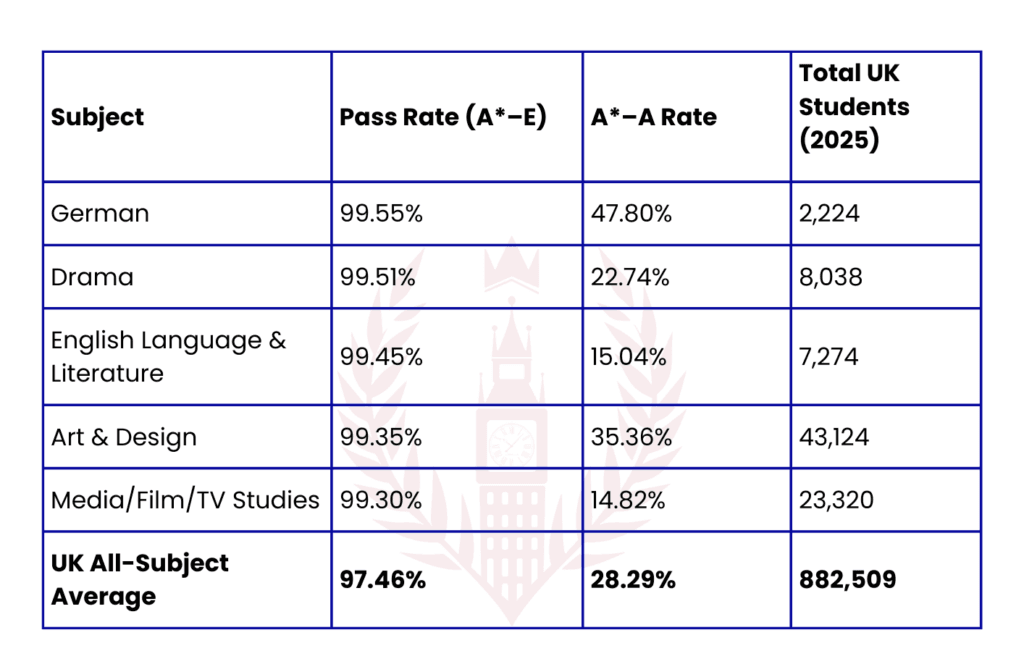
Five A-level subjects have pass rates above 99% in 2025, based on JCQ data. German leads at 99.55%. Drama sits at 99.51%. English Language and Literature comes in at 99.45%, Art and Design at 99.35%, and Media/Film/TV Studies at 99.30%. Well, but can they be called “the easiest A Levels” among all the other subjects?
The UK average across all subjects is 97.46%, based on 882,509 entries from the June 2025 series. But a high pass rate and an easy ride are not the same thing.
Here is what the data shows, and what it leaves out.
Table of Contents
How “Easiest” Was Defined for This Post
Not every measure of difficulty is useful. Student surveys and anecdotal rankings vary too much to be reliable.
This post uses one metric: the percentage of students achieving grades A* to E in the June 2025 series. That is the official pass threshold for A-levels in England, Wales, and Northern Ireland. A grade E counts as a pass. Anything below is an Unclassified result.
The figures come from the Joint Council for Qualifications 2025 A Level Results, published 14 August 2025. JCQ collates results across all major awarding bodies including AQA, OCR, Pearson, and WJEC. The dataset covers the full UK.
The Easiest A-Level Subjects in the UK by Pass Rate (2025)
Five subjects sit clear of the national average by more than two percentage points. The table below shows their pass rates, top-grade rates, and total student numbers.
German (99.55% Pass Rate)
German has the highest pass rate of any mainstream A-level subject in the UK. Only 2,224 students sat the qualification in 2025, which is a small cohort by A-level standards.
That size matters. A significant share of A-level German students are heritage or native speakers. Students who already speak German at home tend to do well across the oral, listening, and written components. This lifts the group’s overall results above what a general-ability cohort would show.
The A*–A rate of 47.80% is the highest of the five subjects listed here. But it reflects that same demographic advantage, not the content difficulty.
Drama (99.51% Pass Rate)
Drama had 8,038 entries in 2025, making it the largest cohort in the top three.
Assessment combines written analysis of texts and theatre history with practical performance and production work. That split reduces dependence on pure exam performance, which is where students most often fail other subjects.
The A*–A rate of 22.74% is well below German. This is the pattern across high-pass subjects: easy to get over the line, harder to reach the top.

English Language & Literature (99.45% Pass Rate)
This combined qualification suits students who sit between the pure analytical focus of Literature and the linguistic study of Language.
Assessment involves reading and writing tasks across both modes. That gives students more ways to show their ability.
The A*–A rate of 15.04% is the second lowest in this group. Most students pass with ease, but top grades are less common.
Art & Design (99.35% Pass Rate)
Art & Design has the largest student cohort of any subject in this list, at 43,124 entries. It spans multiple disciplines including Fine Art, Graphic Design, Photography, and Textiles.
The qualification is portfolio-heavy. Most of the grade comes from coursework built over two years. That structure removes much of the time-pressure risk that causes students to fail in other subjects.
The A*–A rate of 35.36% sits above the all-subject average of 28.29%. For students with genuine creative ability, Art & Design offers a path to strong grades, not just a pass.

Media/Film/TV Studies (99.30% Pass Rate)
Media/Film/TV Studies combines practical production work with analytical frameworks covering representation, audience theory, and media language.
The 99.30% pass rate reflects how accessible the entry-level content is. Most students encounter this subject matter every day.
But the A*–A rate of 14.82% is the lowest in this group. It is the lowest of any subject in the top ten by pass rate. Reaching a top grade requires confident theoretical writing, which many students find harder than the practical side.
Passing Is Not the Same as Performing
A grade E is technically a pass. Universities know this too.
Most degree programmes set a minimum entry grade. For competitive courses, that minimum is often B or above. Some courses ask for an A in the relevant subject.
A pass rate of 99% tells you how many students cleared the lowest possible bar. It says nothing about where most students actually land.
Media/Film/TV Studies shows this clearly. Its pass rate is 99.30%. But only 14.82% of students reach A* or A.
That means most students in one of the highest-pass subjects nationally still finish below an A grade.
There is also a grade boundary effect at work. Ofqual sets grade boundaries after results come in, based on how the cohort performed. In subjects where many students score well, the mark required for each grade tends to be higher. An easier subject can carry stricter grade boundaries at the top end than a harder one.
Does Picking an “Easy A Level” Actually Help You?
Pass rate data tells you about a cohort. It does not tell you about you.
The group taking German A-level is very different from the group taking Chemistry. A subject’s pass rate reflects who chooses it and why. High-pass subjects often attract students already strong in that area.
The more useful question is whether a subject matches how you think and work. Students who enjoy essay writing tend to do well in English Literature, whatever the pass rate says.
Students who dislike performance won’t benefit from Drama’s coursework weighting, even with a national pass rate of 99.51%.
It is also worth checking specific course requirements before choosing. Individual universities list the A-levels they want for each degree on their own websites. Some degrees still require specific subjects regardless of what pass rate data suggests.
Frequently Asked Questions
Is Drama A-level respected by universities?
Yes. Drama is accepted for a wide range of degree courses including Law at several selective universities.
The Russell Group no longer publishes a preferred subjects list. It replaced that with Informed Choices, a tool that maps A-level combinations to degree options at member universities. Always check the entry requirements for the specific course you are targeting.
Does the A-level pass rate vary by exam board?
Yes. AQA, OCR, Pearson, and WJEC each set their own papers, mark schemes, and grade boundaries for the same subject.
The JCQ national pass rate is a combined figure across all boards. Your result can differ based on which board your school uses and how that year’s grade boundaries were set. Ofqual publishes grade distribution data across boards for most subjects each year.
What A-level subjects do universities not accept?
Most universities accept all standard A-level subjects. The exceptions are General Studies and Critical Thinking, which many universities exclude from offer conditions.
A small number of courses at selective universities also exclude Applied A-levels. The safest step is to check the entry page for each course directly, as policies differ between universities and degrees.
These figures are a starting point, not a strategy. Students who do well at A-level are not the ones who chased the highest pass rates. They are the ones who picked subjects that suited them.
The data shows which subjects have the highest floor. Only you know which ones have the highest ceiling.
If you are working through your subject choices, a school advisor or subject specialist can help you weigh these figures against your actual course requirements and goals.


