
“The Hardest A Levels”: Subjects with the Highest Fail Rates

“The Hardest A Levels”: Subjects with the Highest Fail Rates
Five A-level subjects stand well above the UK average for fail rates in 2025. Physics leads at 4.56%. Chemistry follows at 4.28%, then Computing at 4.26%, Biology at 4.08%, and Law at 3.77%. The national average fail rate across all subjects is 2.54%, based on 882,509 entries in the June 2025 series. For many students these subjects are “the hardest A Levels”. But are they actually so?
These numbers measure who sat each exam as much as they measure difficulty. Here is what the data shows, and where it reaches its limits.
Table of Contents
How “Hardest” is Defined Here
This post uses one metric: the percentage of students receiving a U grade in the June 2025 series. A U means Unclassified. It is the only result that does not count as a pass at A-level.
The figures come from the JCQ 2025 results, published 14 August 2025. JCQ collates results across AQA, OCR, Pearson, WJEC, and CCEA. The dataset covers the full UK.
Two subjects have higher fail rates than Physics: Accounting at 6.23% and Environmental Science at 5.02%. Both are excluded from the main list. Each had fewer than 2,400 entries in 2025, small enough that a few poorly-performing school cohorts can shift the national figure.
The five subjects below each had at least 14,000 entries. That scale makes the figures meaningful.
The Hardest A-Level Subjects in the UK, Ranked by Fail Rate
Five mainstream subjects sit above the 2.54% national average by a clear margin. The table below shows their fail rates, A*–A rates, and total student numbers from the JCQ 2025 UK-wide data.
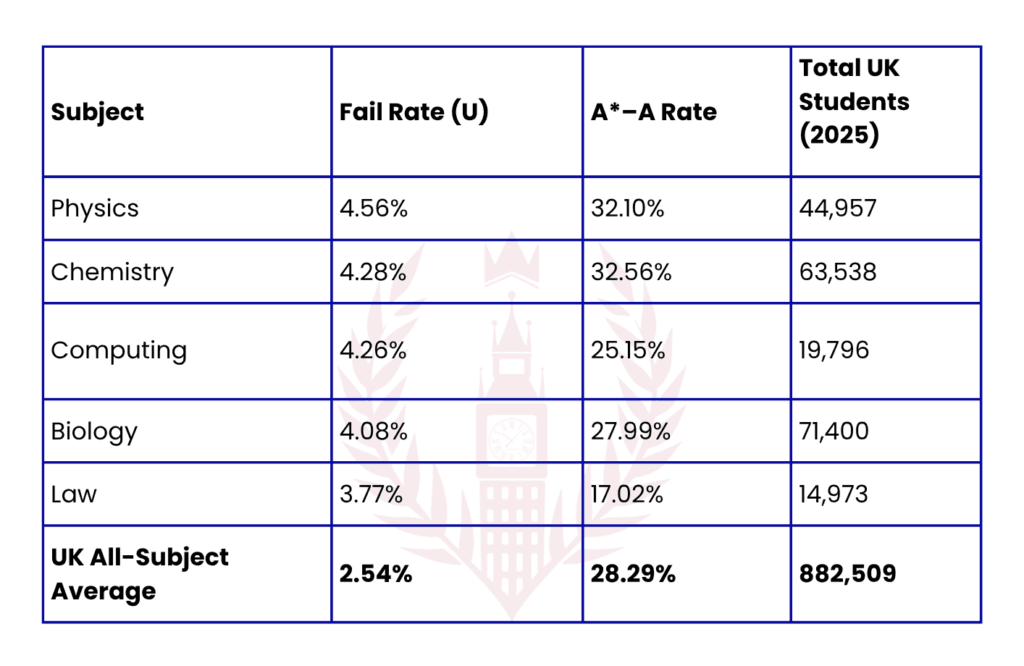
Physics (4.56% Fail Rate)
Physics has the highest fail rate of any mainstream A-level in the UK, across a cohort of 44,957 students.
The subject demands fluency in abstract concepts with no real GCSE equivalent. Quantum mechanics, thermodynamics, and electromagnetism are not harder versions of GCSE topics. They require a new way of thinking, built from scratch.
Mathematical precision compounds this. A small algebra error in a multi-step problem can invalidate the full answer. Students who passed GCSE Physics with ease often find the A-level jump steeper than expected.
Chemistry (4.28% Fail Rate)
Chemistry’s difficulty comes from two sources: the volume of content and the way exams test it.
The A-level covers organic chemistry, thermodynamics, electrochemistry, and spectroscopy. Each topic builds on the previous one. Falling behind early in the course tends to create compounding gaps.
Exams rarely test recall in isolation. Students must apply theory to unfamiliar practical scenarios. Rote learning is not enough to answer the harder questions.

Computing (4.26% Fail Rate)
Computing is the most deceptive subject on this list. Many students choose it because they enjoy gaming or casual computer use. Neither prepares them for A-level content.
The course splits into two parts: programming and theory. Programming requires working in Python or Java to solve structured problems. Theory covers data structures, algorithms, Boolean logic, and how systems operate at a low level.
Most students arrive with no formal programming background. The learning curve in the first term is steep. There is no GCSE equivalent that covers the same depth.
Biology (4.08% Fail Rate)
Biology has the largest cohort in this list, at 71,400 entries. Its 4.08% fail rate represents over 2,900 students receiving a U grade in a single year.
The subject is content-heavy. Students cover cell biology, genetics, ecology, physiology, and biochemistry. Each area carries significant detail.
Exam questions expect students to link multiple biological systems across topics. Recalling isolated facts is not enough. The gap from GCSE to A-level Biology is wider than most students expect, because GCSE content is largely descriptive where A-level content demands analytical application.

Law (3.77% Fail Rate)
Law is the only subject in this list with no GCSE equivalent. Students arrive with no prior exposure to legal vocabulary, case structures, or statutory frameworks.
The first term carries one of the steepest learning curves at A-level. Students must build working knowledge of contract law, tort, criminal law, and constitutional principles from scratch. They must also memorise landmark case names and precise outcomes.
Exams use a problem-question format. Students receive a fictional scenario and must identify the relevant law, explain it, and apply it accurately to the facts. Finding the right legal principle earns partial credit. Misapplying it does not.
Why the Fail Rate Does Not Tell the Full Story
A fail rate of 4.56% still means 95.44% of Physics students passed. The subject with the highest fail rate in the UK still has a strong pass majority.
The more telling issue is who sits these subjects and why. Physics and Chemistry are entry conditions for Medicine, Engineering, and Veterinary Science.
Many students take them not because they are suited to the content, but because a university place depends on it. That forced enrolment effect pushes fail rates above what a purely voluntary cohort would produce.
The grade picture reinforces this. Ofqual’s 2025 results data shows Chemistry’s A*–A rate of 32.56% sits above the national average of 28.29%. Physics sits at 32.10%. Both subjects finish above average at the top end, even while carrying above-average fail rates at the bottom.
Both figures are shaped by who chose to sit the exam. These subjects tend to split results sharply: students who are well-matched do well, and students who are not tend to struggle. The fail rate alone cannot show you which group you are likely to fall into.
The Further Maths Anomaly
Most teachers and students regard Further Maths as the most demanding A-level in the curriculum. It covers pure mathematics, mechanics, statistics, and discrete maths at a depth most students never encounter before university.
Yet its fail rate in 2025 was just 1.93%, lower than standard Maths at 3.54%.
The explanation is self-selection. Only students already taking A-level Maths can access Further Maths. In practice it almost exclusively attracts students who are genuinely strong in Maths. Students self-filter before the exam series begins.
This matters for how you read the fail rate table. A low fail rate does not mean a subject is easy. A high fail rate does not mean a subject is impossible.
Who chose to sit the exam shapes both figures. The data measures cohort performance, not difficulty on its own.
Frequently Asked Questions
Is Physics harder than Chemistry at A-level?
The fail rates are close: Physics at 4.56%, Chemistry at 4.28%. A gap of 0.28 percentage points across very large cohorts does not clearly separate them.
What does differ is the type of difficulty. Physics demands mathematical abstraction and model-based thinking. Chemistry demands content retention and practical application. Students who struggle with abstract reasoning tend to find Physics harder. Students who struggle with information volume tend to find Chemistry harder.
Does taking a harder A-level improve your university application?
For specific degree courses, yes. Medicine typically requires Chemistry and usually Biology. Engineering typically requires Physics and Maths. These are stated entry conditions at most UK universities, not preferences.
Outside of subject-specific requirements, there is no general rule. Admissions decisions rest on grades and predicted grades, not on how a subject ranks on a difficulty list.
Which A-level has the lowest A* rate?
Based on the JCQ 2025 UK-wide data, English Language has the lowest A* rate of any mainstream subject, with just 2.43% of students reaching the top grade. Media/Film/TV Studies sits at 2.41%.
Both subjects carry very high overall pass rates. A subject can be straightforward to pass and very hard to master at the same time.
The data shows which subjects carry the highest statistical risk. It does not show whether you are the student who lands in the 4.56% or the 95.44%.
That is the question worth answering before enrolment, not after. A school advisor or subject specialist can help you work out where your strengths actually sit before you commit to your choices.


