
Online Education vs. Offline Education: Which Option is Better for You ?
Online Education vs. Offline Education: Which Option is Better for You ?
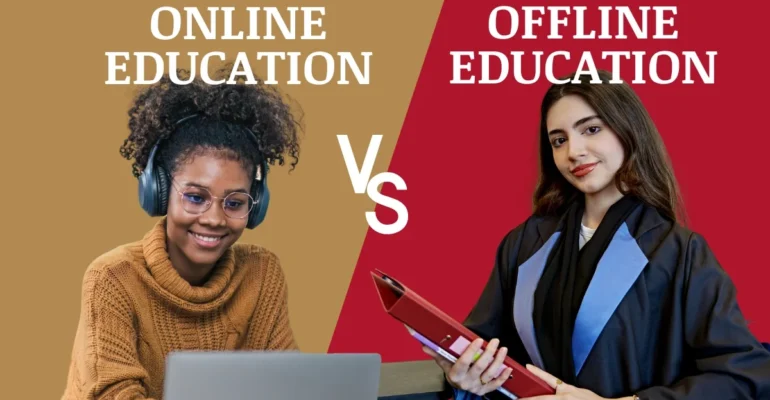
Online education vs. offline education: which is the better option for you? Which one fits your life and learning style? Finding the right type of education that fits your requirements can be quite difficult.
When comparing online learning vs offline learning, each has its own advantages and challenges. Offline education follows the traditional model, while online education provides flexibility and accessibility. Here’s what you need to take into account.
Table of Contents
Accessibility and Flexibility
Offline education requires physical presence, and it has a fixed schedule. On the other hand, with online education, students can learn at any time, as long as they are connected to the internet. That offers remote access, which is great for parents, working professionals, and busy people in general.

Engagement and Interaction
Since in offline education you’re getting face-to-face interaction, which can be great for teamwork and communication skills. You might not have that chance in online education.
However, you do get a variety of interactive lessons (synchronous or asynchronous) and now different AI tools which make your learning process easier and faster.
For some students, it might not be as engaging as traditional courses, though. But you should decide the learning style taking your personality and capacity into account.
The Learning Experience
When you go with online education, you have synchronous or recorded lectures, digital libraries, and all kinds of simulations. You don’t have someone controlling every part of the learning process.
It’s different in offline education, where teachers offer guidance, structured schedules, and so on. The learning experience is more structured in offline education, but you do have more flexibility online, so that’s important to keep in mind.
Costs
Naturally, you do need to think about costs as well. Since offline education requires physical presence on a campus, you usually need to pay more for that, especially if you have to relocate.
With online education, you have more affordable prices. There are also no commuting costs, and digital materials tend to be free, which is a great thing to consider.

Skills and Technology
Since offline you are geared towards hands-on, collaborative, and interpersonal skills, there’s not as much focus on technological skills. However, online, you can build digital literacy, adaptability, time management, and so on.
Clearly, technology is a major part of the process, and it does provide you with a vast array of different solutions to keep in mind. That’s why this is the way to go if tech is what you are most interested in.
Training
When you study offline, you get more hands-on training, which can be super useful. Fields like engineering, performing arts, or medicine benefit from that a lot more than you might expect
On the other hand, online, you have access to AI, VR, and simulations, along with practice-based learning. Granted, it won’t replace hands-on learning, but it will get close, and that’s totally something you need to take into account here.
Feedback and Assessments
Online assessments offer flexibility and convenience, allowing students to take exams from any location and often providing instant feedback through automated quizzes or AI-based grading. This can make the evaluation process faster and more efficient, especially for large groups of students.
Traditional exams, on the other hand, provide a structured environment where students can interact directly with instructors and receive tailored feedback. They often encourage deeper engagement during the assessment and can be more suitable for evaluating complex problem-solving or critical thinking skills.
Career Opportunities
In today’s job market, the career opportunities available after completing an online degree are often comparable to those of traditional degrees. Many employers now value skills and knowledge over the mode of study, especially in fields like business, technology, or design, where online education has become well established.
The main differences lie in the learning experience rather than the final outcome: offline programs often provide stronger face-to-face networking through peers, teachers, and campus activities, while online programs connect students to a more global and diverse network.
For professions that require practical training, such as medicine or dentistry, traditional education remains essential, but in most other areas, both pathways can open similar career doors.

Which is the Better Option?
As always, it depends on what you are looking for. Both offline and online education are great in their own right. Online education is more suitable for those who want affordability, flexibility, and an international or global reach. That being said, you do need to have self-discipline and good technological access, something that matters quite a lot.
When it comes to offline education, this is better if you want to have hands-on learning, structured guidance, and social interaction. It’s not as flexible, and it could get rather costly at times. But if that’s not a problem, it’s clear that you can get an exceptional result with it, and the value you provide is more than expected.
For many people who are balancing work and other responsibilities, online education can be a very practical choice. It still offers access to high-quality learning opportunities and can be a valuable investment of time. As an online distance university, here at London Gate College we offer high-quality online education which open our students the doors to UK.


