
Online – Distance – Remote – Virtual Learning: What Each One Actually Means

Online – Distance – Remote – Virtual Learning: What Each One Actually Means
If you pick up any school brochure, college catalog, or navigate through a university website, you could see these four terms used as if they mean the same word. Parents mix them up. Even schools sometimes mix them up. Most people hear online learning, distance learning, virtual school, and remote learning as four names for one thing.
Online – Distance – Remote and Virtual Learning. They are four different things. And the difference is not just a naming issue.
When an educational institution uses any of these words, it is telling you something real. The word describes how the program is built, how content reaches you, and what the learning space looks like. The problem is that most people have never had a way to decode it.
Why These Four Terms Keep Getting Confused
During the COVID Pandemic, schools across the world shut their doors. Teachers moved their courses online. Parents sat at tables helping their kids log into Zoom or any other online communication app while also trying to do their own jobs.
People called all of it online learning, remote learning, virtual school, and distance education, often in the same line. Actually, the terms started to be confused during and after this term.
Table of Contents
Distance Learning Is the Oldest Concept Here
Before there was internet, before there was laptops, before there was even phones, there was distance learning. The University of Wisconsin-Madison used the term “distance education” in a course catalog in 1892, the first known use of the phrase in the United States. Teachers had been sending lessons by mail since the 1840s, reaching students who lived too far from a city to attend a class.
That original idea is still the one that defines it. Distance learning means the teacher and student are apart by design. Not as a side effect of a health crisis, not as a short-term fix, but as the core structure of the program from day one.
This is why distance learning is the broad concept that all the others sit inside. The word distance says nothing about screens or Wi-Fi. It says something about where the student is.
Online Learning Is the Delivery Method, Not the Location
Here is where the real mix-up begins, because online learning and distance learning look almost the same from the outside. Both use screens. Both use the internet. Both often happen from home. But they describe different things.
Online learning answers the question of how content reaches you. Distance learning answers the question of where you are when it does.
When a course comes through the internet, whatever else is true, that is online learning. A student in a brick-and-mortar classroom whose teacher posts readings on a digital platform is doing online learning. She is not doing distance learning. She is on campus, in a seat, with a teacher nearby.
Now compare that to a student doing a fully online MBA from her home in another part of the world. She is doing both at once. The degree was built for students who will never set foot on campus, which makes it distance learning. All the content comes through internet video and digital work, which makes it online learning. Both labels are right, and they describe different parts of the same program.
Remote Learning Is a Context, Not a Curriculum
This is the term most people think they understand because they lived through it. That lived experience is also exactly what makes it so hard to see clearly.
When COVID-19 forced school closures, what happened was not distance learning. It was not even planned online learning. A team of scholars published a key piece in EDUCAUSE Review in March 2020 that named what schools were actually doing: Emergency Remote Teaching. The goal, they wrote, was not to rebuild a full learning system. It was to give students short-term access to lessons quickly, in a way that was reliable enough to work during a crisis.
That is a different thing from a program built from scratch for students off campus.
Remote learning, used well, describes a short-term shift. A school built for in-person teaching moves to digital delivery because something forced it to.
The tools may look the same as a real distance program. The difference is in the intent, the prep time, and how long the shift was ever meant to last.
Virtual Learning Describes the Environment
If distance learning is about structure and online learning is about delivery, virtual learning is about the feel and function of the space where learning happens.
A virtual learning environment (VLE) is a digital platform built to copy the working parts of a classroom. That means live sessions, discussion boards, grade tracking, peer tools, and direct contact with teachers.
Platforms like Moodle, Blackboard, and Canvas are VLEs. They are not just places to post files. They are designed spaces where the give-and-take of a real classroom can happen through a screen.
Virtual learning does not need physical distance, and this is the thing people get wrong most often. A school could run a virtual classroom inside a physical building, with students logging in from devices at their desks. The learning is virtual. The students are on campus. Both things are true at once.
The Four Terms Side by Side
Here is the cleanest way to see how each term maps to a different part of the learning picture.
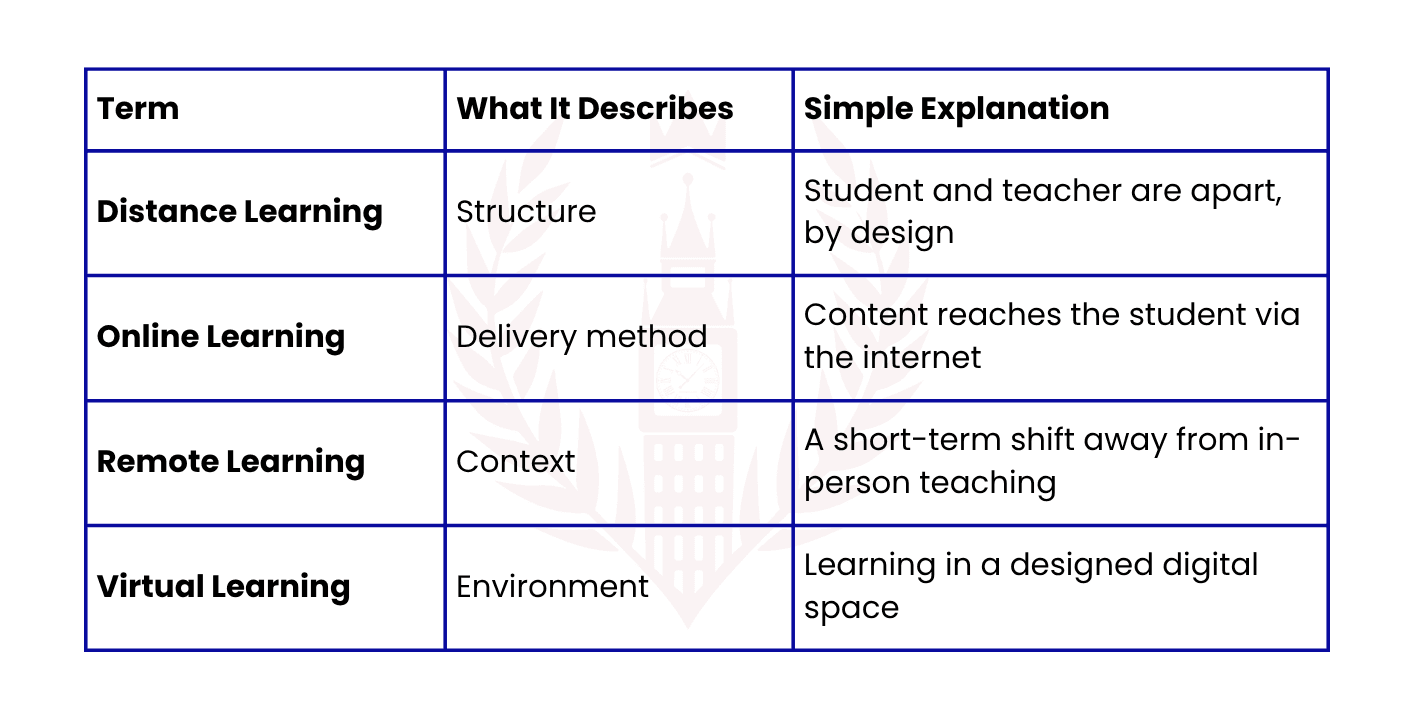
One program can carry more than one label at once. A fully online degree taken from home is distance learning by structure, online learning by delivery, and virtual learning by environment, all at the same time. That is not a problem. It is just how the layers work.
Online Learning vs. Distance Learning: The Most Searched Pair
These two cause more confusion than any other pairing because their overlap is real. But there is a clean way to pull them apart.
Online learning is how you learn. Distance learning is where you learn.
A student in an online degree program studying from home somewhere in the world is doing both. The degree is built for students who will not be on campus, which makes it distance learning. The content comes through internet video and digital work, which makes it online learning.
Neither label is wrong. They describe different features of the same program.
Now picture a high school student whose teacher runs quizzes through an online platform, with the whole class in the same room. That student is doing online learning. But they are on campus with a teacher nearby, so it is not distance learning in any real sense. The overlap is genuine. The labels still point to different things.
Remote Learning vs. Distance Learning: Two Very Different Things
This is the difference that matters most when you are looking at a real school or program.
Distance learning is a built system. Courses are made from scratch for students who will not be in a physical room. The pace, the tests, the way students talk to each other, and the teacher’s whole approach are shaped around the fact that no one is coming in. Building a real distance program well takes months, sometimes more.
Remote learning is a shift. A school built for in-person teaching moves online because a crisis pushed it to. Nothing about those original courses was made for digital delivery. The teacher does their best in a format they did not plan for.
The gap shows up in the experience almost right away. Distance programs have built-in peer tools, structured boards, and teachers who know how to build real connection across a screen. Emergency remote setups tend to feel like a class moved to a video call: same plan, same timing, totally different medium, and nobody quite sure if it is landing.
Remote learning is a shift. Distance learning is a system. If a school says it offers remote learning, ask whether that describes a real program or a backup plan no one has tested.
Frequently Asked Questions
Is remote learning the same as distance learning?
No, and the gap is sharper than most people realize. Distance learning is a built system, made for students who will not be on campus. Remote learning, as most families lived it during the pandemic, was what scholars call Emergency Remote Teaching: a crisis move aimed at keeping lessons going, not at quality design.
Both can run on the same tools. But one was built over months for a specific type of student, and the other was put together in days to keep the lights on.
Can I earn an accredited degree through distance learning?
Yes. Hundreds of accredited colleges offer full bachelor’s, master’s, and doctoral programs through distance formats, with the same standards as their on-campus programs. The format is mainstream, not a workaround. This is what we do here at London Gate College. As an online distance university, we provide our students best practices of distance learning.
What is virtual learning for K-12 students?
In K-12, virtual learning means enrollment in a school that runs fully through a designed digital platform: set sessions, structured courses, and the same state-level tests as any other public school. A K-12 virtual school is a designed program with a staff, a schedule, and a structure. It is not a makeshift fix.
Does online learning produce the same results as in-person learning?
Research points to a small but real edge for well-built programs. A second-order meta-analysis in Educational Research Review drew on 19 prior studies. It found that distance learning produced outcomes roughly a sixth of a standard deviation higher than face-to-face teaching. The edge was stronger in college settings than in K-12. Course design, teacher training, and student drive shaped results far more than the format itself.
The Design Matters More Than the Label
The label a school puts on its learning program tells you much less than the story behind it.
Distance learning works when it was built to work. Online learning works when the teacher actually knows how to teach that way. Virtual spaces work when the platform was chosen because it helps students learn, not because someone needed to post files somewhere. Emergency remote teaching, no matter what a school calls it, is none of those things, because it was built to get through the week, not to educate.
When a school uses any of these terms, the question that matters is not what type of learning this is. It is: how long did it take to build this, and who was it built for?
That question applies to college programs, K-12 virtual schools, and any school that sends a digital notice on short notice. The terms give you the words. The answer tells you whether you are looking at a real program or a plan made under pressure.


