
What Is Financial Leadership?

What Is Financial Leadership?
Financial leadership is the ability to turn financial insight into clear decisions and direction for a whole business. It’s not the same as being the most skilled person on a finance team. And it’s not the same as financial management, which is where most finance careers begin.
Financial leadership is the practice of using financial knowledge to guide a business toward its goals. That means reading the numbers. It also means explaining what those numbers demand to people who don’t live in them every day.
Table of Contents
Financial Leadership vs Financial Management
Financial management and financial leadership both need a firm grasp of numbers. But they point in very different directions.
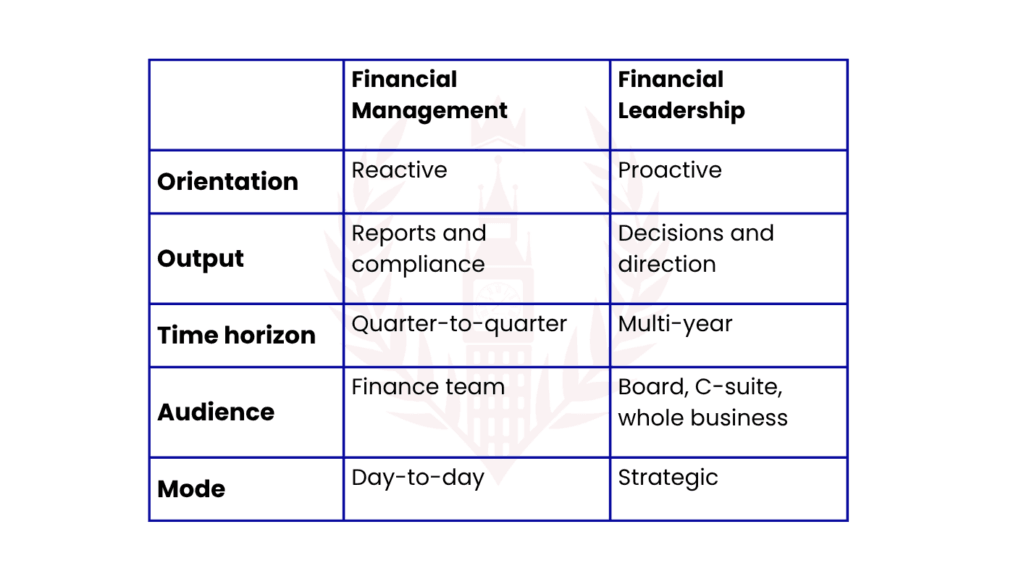
Strong finance management is the base. A finance leader who can’t manage numbers well has nothing to work with. But managing numbers well alone doesn’t make someone a finance leader.
A McKinsey survey found that CFOs still spend roughly 60% of their time on routine finance work. That’s true even as their role now covers strategy, digital change, and decisions that affect the whole company. The gap between what the job demands and where the time goes is one of the key tensions in finance right now.
Think of it this way. A finance manager produces a cash flow report. A financial leader uses that same report to make the case for a new hire, a market shift, or a cost cut.
What Financial Leaders Actually Do
Financial leadership isn’t a job title. It’s a practice. A CFO who spends all their time closing the books isn’t leading with finance. A business unit head who reads cash flow well and makes a clear case for capital can be.
According to Gartner’s 2025 CFO research, over 70% of CFOs now carry duties that go well beyond routine finance. Those duties include tech plans, workforce choices, and risk. Finance has become the part of a business with the clearest view of the whole thing.
That shift is changing career paths. When a CFO can speak to strategy and not just report on it, the door opens to a bigger role in how the business is run.
Finance leaders spend time in rooms well outside of finance. They sit in on product reviews, hiring calls, and board sessions.
They ask what the numbers mean for what happens next. That’s what turns a finance role into a leadership role.

Why the Financial Leadership Bar Has Moved
The bar hasn’t crept up. It’s jumped.
Between 2016 and 2021, the share of finance leaders in charge of their company’s digital work more than tripled, according to a McKinsey Global Survey on the CFO’s role. Duties around investor relations grew from 44% of CFOs to nearly 66% over the same stretch.
Three things are driving this. First, AI is taking on more of the routine work, freeing up finance for bigger thinking.
Second, boards now want forward-looking insight, not just a read of last quarter.
Third, decisions about hiring, tech, and daily ops all carry financial weight. Someone needs to speak to that weight clearly.
Financial leadership is more and more than that someone.
Core Skills of a Financial Leader
Financial skill is assumed. These four things set a finance leader apart from a skilled finance expert.
Financial storytelling: The skill of turning data into a story others can act on. Numbers without context don’t shift decisions. A finance leader knows what the data means for the business and can say it clearly in a board meeting or a budget talk.
Forward-looking analysis: Reporting on the past tells you where you’ve been. Financial leadership means scenario planning, cash flow forecasting, and stress testing. The key question is what happens next, not what happened last quarter.
Influence across teams: A finance leader builds trust outside the finance team. That means asking sharp questions in product, HR, and ops talks, and helping shape calls that go beyond the numbers.
Strategic resource choices: Deciding where money should go is different from tracking where it went. A finance leader brings a long view and clear reasoning to spending calls, not just a short-term read of the books.

Frequently Asked Questions
What is the difference between a CFO and a financial leader?
A CFO is a job title. Financial leadership is a practice, and the two don’t always go hand in hand. A 2025 Fortune analysis found that 34% of CFOs who left their roles that year moved into President or CEO jobs, up from 20% the year before. The skills that financial leadership builds, across strategy, clear communication, and business influence, travel well beyond a single title.
Can non-finance executives practice financial leadership?
Yes. A CEO who knows their burn rate and argues for capital with financial clarity is doing it. So is a product manager who builds a business case grounded in margin data. Financial leadership belongs to anyone who uses financial thinking to make sharper calls and shape what others decide to do.
What background do you need for financial leadership?
There’s no single path. Most finance leaders hold a finance or accounting degree, and many carry a CPA, CFA, or MBA. But the skills that matter most in the role, like scenario analysis, clear communication, and influence across teams, come from time spent in rooms where big decisions get made.
This often means taking on work that stretches beyond routine reporting, sitting close to the CEO or board, and getting used to making calls with incomplete data.
Is financial leadership different in small businesses vs large ones?
In a small business, one person often handles both the routine work and the strategic thinking at once. In a large company, that work spreads across a team, with the CFO setting direction. The core job is the same: use financial insight to guide decisions well. The scale just changes.
The finance team has never had more data or more to answer for. The question financial leadership addresses isn’t “what do the numbers say?” Most finance teams can handle that. The harder question is what the business should do about it, and whether the person holding the numbers is the one making that case.
Not every finance team has someone in that role yet. But when it does, the business tends to know it.


