
Personal Mission Statement for Students: Why It Matters and How It Shapes Your Future

Personal Mission Statement for Students: Why It Matters and How It Shapes Your Future
A personal mission statement is a short, private statement of your values, purpose, and direction. You don’t submit it anywhere. No university reads it, no admissions tutor scores it, and no deadline triggers it.
It exists to help you make better decisions about your own life.
Students often find the term while preparing for university applications. That timing creates confusion. A personal mission statement is not a personal statement, and it’s not a motivation letter. This post explains the difference and shows you how to write one.
A personal mission statement captures your core values, the impact you want to have, and the direction you’re moving in. Think of it as a filter for decisions, not a document for deadlines.
Table of Contents
What Is a Personal Mission Statement for Students?
A personal mission statement lives with you. You write it, revise it over time, and use it to check whether the choices in front of you fit who you’re becoming.
According to the 2016 Gallup Student Poll, engaged students are 2.5 times more likely to report excellent grades than their disengaged peers. Purpose builds that engagement. A mission statement is how you start to develop it.
The same Gallup research found that only about one-third of students in 10th, 11th, and 12th grade are engaged with school. That figure drops as students get older. Older students are more likely to have lost the thread of why any of it matters.
Why Students Need a Personal Mission Statement
Most students make choices by default. Subject picks, activities, and work experience get chosen based on what seems safe, not what genuinely fits.
A 2022 Heliyon study found that students with a clear sense of life purpose develop a stronger academic identity, which connects to better grades. The link isn’t direct. It runs through identity: students who know what they’re about tend to act like students.
Writing a personal mission statement does three things.
- It sharpens your choices when options compete.
- It gives you clearer material when writing any application document.
- And it gives you something to hold onto when the process gets hard.
Personal Mission Statement vs Personal Statement
These are very different documents with different audiences and different purposes.
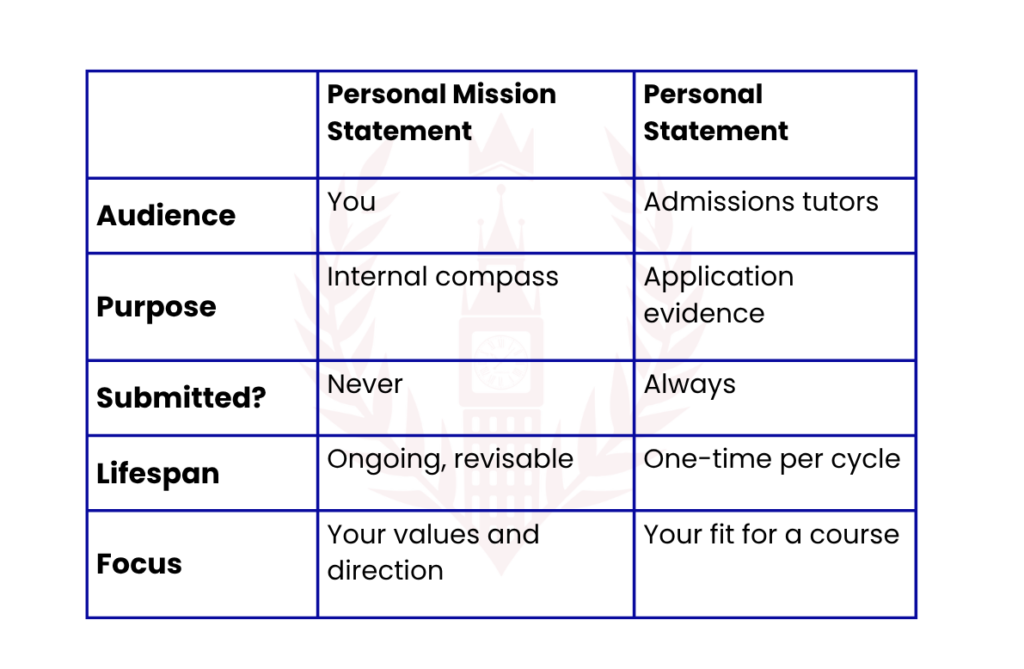
UCAS changed its personal statement format for 2026 entry from one open essay to three structured questions. Each targets specific evidence: your subject interest, your skills, and your wider context.
None of those questions ask for your values in abstract terms. That’s what your mission statement is for. These are different documents and they are never the same thing.
Personal Mission Statement vs Motivation Letter
A motivation letter is a formal application document, often required for graduate programmes or overseas scholarships. It answers one question: why this programme, at this institution, right now?
Your mission statement answers something broader and internal: why any of this at all?
A motivation letter is programme-specific and submitted. Your mission statement belongs to you alone.

How to Write a Personal Mission Statement
Step 1: Name your core values: Pick three to five: honesty, curiosity, fairness, or whatever words actually describe how you make decisions. Not the ones that sound good. The real ones.
Step 2: Define your impact: Who do you want to help, or what do you want to change? “Making a difference” is not an answer. “Making science accessible to people who were told they couldn’t do it” is.
Step 3: Name your direction: Not a job title. A way of operating. “I want to build things that last” works better than “I want to be an engineer.”
Step 4: Draft it and read it aloud: If it sounds like it could belong to anyone, it isn’t done. Cut what’s borrowed. Keep what only fits you.
Personal Mission Statement Examples for Students
Year 11 student: “My mission is to ask better questions than the ones I’m given. I want to understand the science behind what most people take for granted, and use that to teach people who’ve been told they’re not science people.”
A-level student: “I’m here to learn how to think, not just what to think. I want to build a mind that can look at a problem in law, in policy, or in everyday life, and find what everyone else missed.”
University applicant: “My mission is to work where research meets public understanding. I want to make findings useful to the people most affected by them, not just the people who fund them.”
Scholarship applicant: “My mission is to be a first-generation student who opens doors for the next ones. Every chance I get is one I intend to pass forward.”

Frequently Asked Questions
Is a personal mission statement the same as a personal statement?
No. A personal statement is a formal document reviewed by admissions staff to assess your fit for a course. A personal mission statement is a private document you write for yourself. Submitting your mission statement won’t work as an application, since it doesn’t answer what universities are actually asking.
How long should a student’s personal mission statement be?
Two to four sentences is the right range. Longer usually means less clear. As your direction becomes more specific, you can expand it. For now, aim for a version that fits in one short paragraph and says something true.
Can I use my personal mission statement in a university application?
Not directly. Use it as source material, not as text you paste in. Re-read it before you draft any application document. It will show you which of your experiences connect to what you care about, and which ones you’re adding only to fill space.
When should I write my personal mission statement?
Before you write any application document. Ideally at the start of Year 12, when your choices are still being shaped. A Gallup and Bates study found that more than 80% of graduates want purpose from their work, but fewer than half find it.
That gap doesn’t start at graduation. It starts in the years when nobody thought to ask the question.
Your personal statement has a deadline. Your personal mission statement doesn’t. That’s exactly why most students never write one.
The students who do already know what they want to say when the deadline arrives. They worked that out first.


